0%
Loading ...




Municipal planning allows identify the needs for improvement, renovation, expansion, or construction of a municipality’s sports facilities and spaces. Having a specific planning tool helps the local authority to to understand the current situation of its sports network, anticipate future needs, and guide decision-making in matters of sports investments and policies.
In this context, the Map of the municipality’s sports facilities and equipment becomes a strategic tool for defining how the local sports system should evolve and adapt it to the characteristics of the territory and the needs of the population.
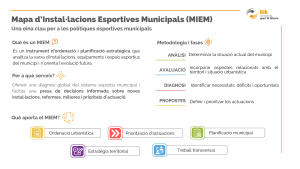
The Map of Municipal Sports Facilities and Equipment (MIEM) It is a planning tool that analyzes the municipal sports system and establishes the guidelines that will guide the evolution of the network of sports facilities and spaces over the coming years.
The MIEM offers a Global diagnosis of the municipality’s sporting reality, taking into account:
• Demographic, territorial, and urban planning characteristics.
• The population’s sports participation and habits.
• Municipal, association, and private sports offerings.
• Current demand and future needs.
• The condition, uses, and level of use of the facilities.
• The sports facilities at educational institutions.
• Open-access areas and spaces located in the natural environment.
• New trends in the field of physical activity and sport.
This analysis facilitates an informed decision-making on the construction of new facilities, the renovation or expansion of existing facilities, the reorganization of uses, and the prioritization of municipal investments.
The MIEM also incorporates the perspective of Active urbanism, linking sports facilities with public space, active mobility, pedestrian and bicycle routes, and the rest of the urban network. The goal is to foster an active, accessible municipality capable of facilitating physical activity for the entire population.
The MIEM is framed within the Master Plan for Sports Facilities and Equipment in Catalonia (PIEC)the instrument through which the Generalitat de Catalunya plans, promotes, and coordinates actions related to sports facilities in the territory.
For this reason, its development must take into account urban planning, sports facility networks, territorial needs, and the applicable technical criteria regarding safety, functionality, livability, accessibility, inclusivity, and energy efficiency.
In this way, the MIEM allows To link municipal sports planning with the general framework for territorial planning and sports facilities in Catalonia.
The work methodology is adapted to the characteristics and needs of each territory and is structured into four main phases:
Analysis
This phase allows us to understand the municipality’s current situation by studying the demographic, geographic, social, and territorial context. It also analyzes sports participation, the existing supply, demand, the needs of different groups, and the network of sports facilities, equipment, and spaces available.
Evaluation
The condition of the facilities, the functionality of the spaces, the uses, occupancy levels, and the conditions of accessibility, safety, and efficiency are assessed. This phase also includes an analysis of the territory and urban planning, identifying land designations and the possibilities for development or transformation of the various sports areas.
Diagnosis
Based on the information gathered, the needs, deficiencies, potential non-compliances, and opportunities for improvement of the municipal sports network are identified. The diagnosis allows determining which facilities require maintenance, renovation, expansion, or replacement, as well as detecting possible shortcomings in the range or territorial distribution of the spaces.
Proposals and prioritization
Finally, the necessary actions are defined for the short, medium, and long term, based on the needs identified, the feasibility of the interventions, and the resources available. Proposals may include actions on existing facilities, the construction of new spaces, the reorganization of uses, the improvement of accessibility, the optimization of schedules, or the introduction of new models of sports practice. The process is complemented by documentary analysis, technical visits to the facilities, and the comparison of information with municipal officials and the main stakeholders of the local sports system.
MIEM is not just an inventory of facilities. It is a strategic tool. which allows for linking the facilities to the municipality’s sporting, social, territorial, and urban reality. Its development allows the network of sports spaces to be aligned with municipal policies and the needs of the citizens, sports entities, educational centers, and other stakeholders involved in physical activity and sports.
At the same time, it promotes Cross-departmental collaboration between the Sports Department and other municipal departments., especially Urban Planning, Education, Youth, Health, Environment, and Mobility. This coordination makes it easier to integrate sports activities into a broader municipal strategy aimed at building an active, healthy, inclusive, and sustainable municipality.
The main benefits of an MIEM include:
• An up-to-date diagnosis of the network of sports facilities, equipment, and spaces.
• An understanding of supply, demand, usage, and occupancy levels.
• The identification of needs, deficiencies, and opportunities for improvement.
• The prioritization of maintenance, renovation, expansion, or new construction projects.
• A technical basis to justify investments and seek potential funding sources.
• Better coordination among the different municipal departments.
• The integration of sports facilities into urban and regional planning.
• The adaptation of the sports network to the present and future needs of the population.
• The strengthening of the Sports department’s position within the municipal organization.
• The definition of a roadmap for the development of local sports policies.
Itik Consultoria has been working on the development of MIEMs since 2006 and has extensive experience in planning municipal sports facility and equipment networks.
Do you want to know how we can adapt the Member for your municipality’s needs? Contact us at Nine hundred thirty-four, one hundred ninety-four, zero one seven or a info@itik.cetrexmarketing.com